Understanding SMT Meaning in Today’s Production
When people talk about electronics manufacturing today, one term appears again and again: SMT. But what is the real SMT meaning?
SMT stands for Surface Mount Technology. It is a method where electronic components are placed directly on the surface of a PCB. No drilling. No big holes. No large parts sticking out.
This technology has completely changed how factories make products like USB cables, HDMI cables, DP cables, and many other digital devices.
Why SMT Meaning Matters for USB, HDMI, and DP Manufacturing
The SMT meaning goes beyond a technical definition.
It is a core process that makes modern devices smaller, faster, and more reliable.
Today’s USB, HDMI, and DisplayPort products are not simple wires. They include chips, controllers, filters, and protection circuits.
All of these small components need stable, precise mounting. And SMT is the best way to achieve that.
SMT Meaning in Our Factory: What Makes Us Different
As a professional USB, HDMI, and DP cable manufacturer, Smartavlink use SMT on a daily basis.
Here are some strengths that set our factory apart:
Advanced SMT lines with high-precision pick-and-place machines
Strong engineering team that understands high-speed signal integrity
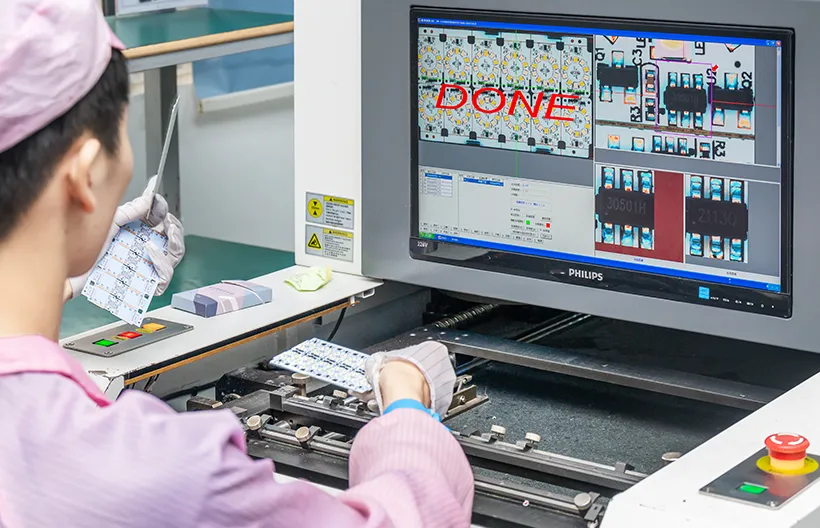
Strict QC process, including AOI and functional testing
Support for custom PCBA designs for cables and adapters
Stable materials from trusted suppliers
Fast delivery, even for large orders
Because we integrate SMT directly into our cable production, Smartavlink can control quality from the very first step. This means better connectors, better performance, and more reliable final products.
Precautions during SMT production
Verify the correctness of the materials at the beginning.
Maintain a clean and tidy working environment.
Determine the appropriate amount of glue to be applied; ensure that no excess or insufficient glue is used during component placement.
During component placement, ensure the correct position and angle are maintained, and prevent any cracks from forming.
SMT technology is widely used in various of our products, including:
- USB-A to USB-C fiber optic cables with integrated chips;
- Fiber optic cables that comply with USB4 and USB 3.2 standards;
- Fiber optic cables that support HDMI 2.0, HDMI 2.1, and DP 1.4 interfaces;
- Adapters and converters;
- Signal-enhancing circuit boards used within long-distance data cables;
- Power management circuits;
- E-mark chip integration modules for high-power USB-C data cables.
Why SMT Will Continue to Shape the Future of Connectivity
The electronics industry is moving fast.
Devices are getting smaller. Speeds are getting higher. Power delivery is getting stronger.
This means the demand for SMT will continue to grow.
New connector standards, new chip designs, and new smart functions all rely on SMT technology.