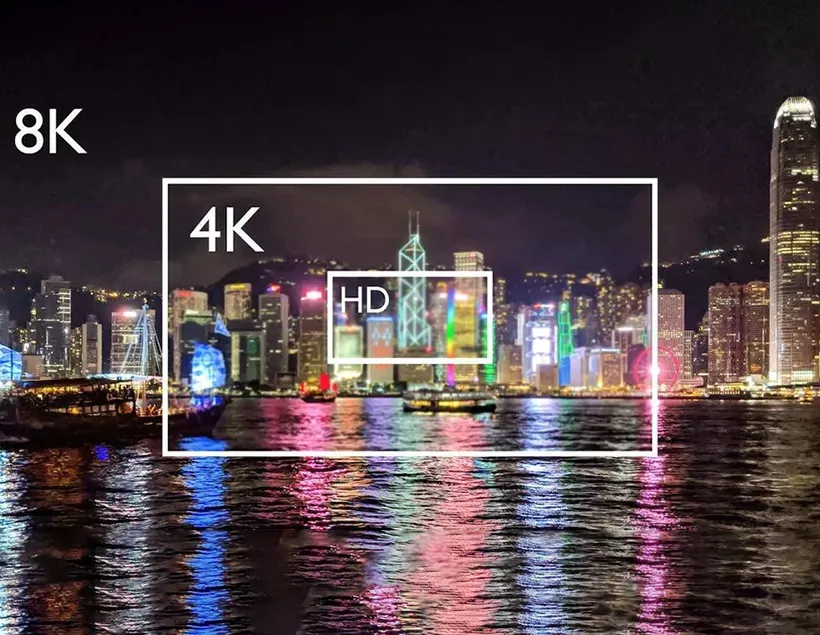
一、Overview of the HDMI interface: Why is it possible for HDMI to support such high bandwidth?
HDMI (High-Definition Multimedia Interface) is a high-speed digital interface that enables the simultaneous transmission of high-definition video and audio.
From the initial HDMI 1.0 to the current HDMI 2.1, the core logic has remained unchanged:
By using multi-channel parallel high-speed transmission, images, audio, and control signals are reliably delivered to the display device.
However, what truly determines the performance limitations of HDMI are:
the definition of the pins and the physical transmission medium used (copper or fiber optic).
二、HDMI Type A (19-pin) – Complete pin definition (Pin 1–Pin 19)
HDMI Type A is the most common type of interface and is widely used in televisions, monitors, graphics cards, and industrial control devices.
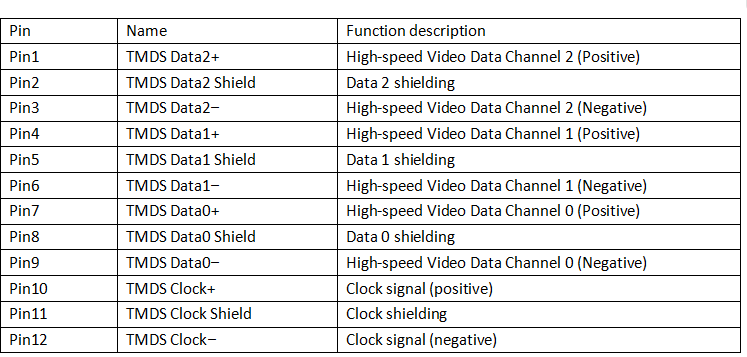
These 12 pins essentially consist of 4 groups of high-speed differential channels:
- Data0 / Data1 / Data2 / Clock
- Each group consists of 3 wires(+/−/Shield)
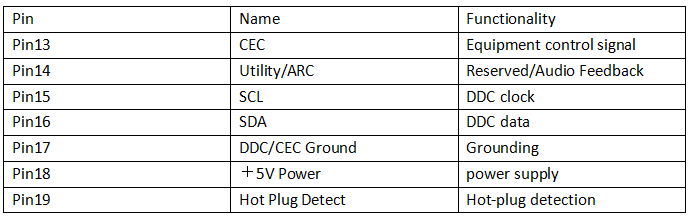
These Pins require low bandwidth but extremely high stability; therefore, copper wires are usually still used in AOC designs.
三、The core design philosophy of HDMI AOC
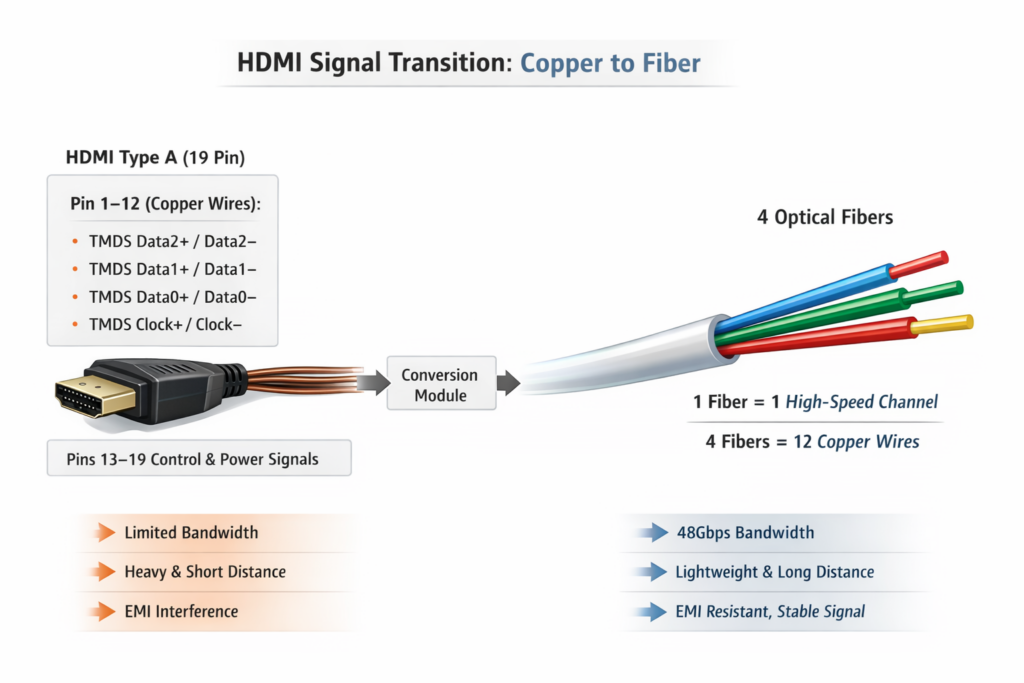
Replacing 3 copper wires with 1 fiber optic cable
In the HDMI AOCs produced by our company:
Physical structure changes:
- 1 fiber optic cable = 1 high-speed channel
- Previously:
- 12 copper wires → 4 sets of TMDS channels
- Now:
- 4 fiber optic cables → Completely replace all high-speed data transmission via Pins 1–12.
4 fibers = 12 high-speed copper wires
The key advantages of using fibers over copper wires:
- Higher bandwidth, with potential for future expansion.
- Copper wires are limited by:
– The skin effect
– Crosstalk
– Attenuation - Fibers, on the other hand:
– A single channel can support 10 Gbps, 12 Gbps, or even higher speeds.

Protection against EMI/RFI interference
- Industrial environments
- Medical equipment
- Broadcasting and television
- Machine vision
Fiber optic cables do not conduct electricity, making them resistant to electromagnetic interference.
They are also lighter, thinner, and easier to install.
- They are of great importance for OEMs and system integrators.
- They are ideal for use in cabinets, within walls, in cable trays, and inside equipment.
四、From HDMI 1.4 to HDMI 2.1: How is the bandwidth calculated?
The essence of HDMI 2.1 being 48 Gbps:
In HDMI 2.1:
- Bandwidth per channel: 12 Gbps
- Number of channels: 4
- 12 Gbps × 4 = 48 Gbps
In the context of AOC (Active Optical Cable):
Each fiber optic cable is capable of carrying one 12-Gbps high-speed channel.

The essence is not that “the version has changed”
but rather that the requirements for single-channel speed and channel stability have become higher. This is precisely the area where copper cables are most prone to failure, and where the advantages of AOC become most evident.
五、Market Pain Points and Customer Concerns
Through long‑term OEM and system‑integrator feedback, the main concerns are:
- Signal instability at high resolution
- Limited transmission distance
- EMI interference in industrial environments
- Thick, inflexible cables difficult to install
- Compatibility issues between different devices
六、How Our HDMI AOC Solves These Problems
- Optical channels with bandwidth margin design
- Strict BER and eye‑diagram testing
- Ultra‑thin, flexible cable structure
- Long‑term stable operation for 24/7 systems
Our HDMI AOC helps customers reduce failure rates, simplify system design, and pass end‑customer acceptance with confidence.
Conclusion
HDMI is fundamentally a four‑channel high‑speed interface. As bandwidth continues to grow, optical fiber replacement is no longer optional but inevitable. HDMI AOC is the future‑proof solution for high‑resolution, long‑distance, and high‑reliability applications.