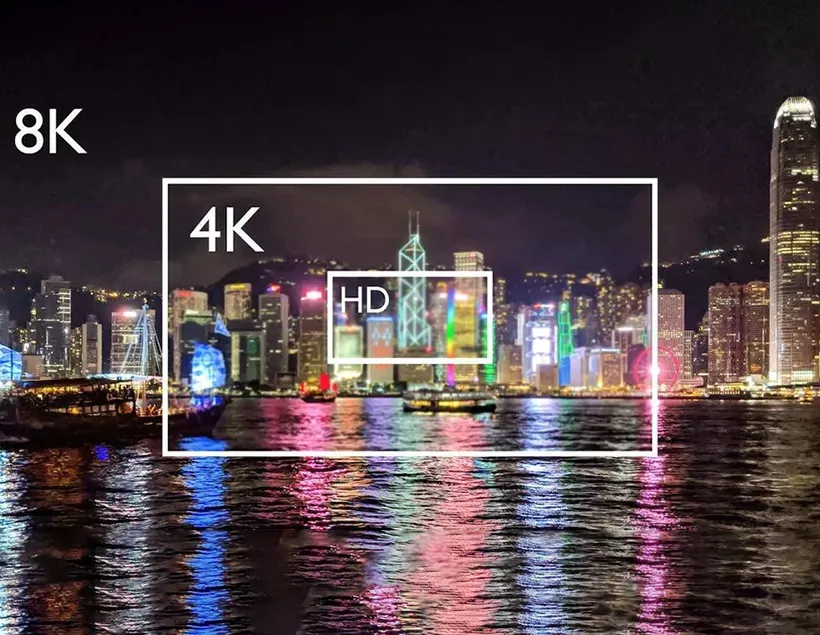
In actual projects, many customers often encounter such issues when choosing USB 3.0 cables.
- When the distance increases, the signal becomes unstable.
- The screen flickers, and the device loses connection.
- It’s unclear why USB fiber cables have a “direction” in which they should be used.
- I’m worried that if one component of this cable fails, the entire cable will become unusable.
To truly understand these issues, we need to start by explaining how USB 3.0 works.
一、 How does USB 3.0 itself achieve high-speed and bidirectional communication?
The most difference between USB 3.0 and the earlier USB 2.0 is that USB 3.0 inherently supports simultaneous reading and writing (full-duplex communication).
This is because in a USB 3.0 connection:
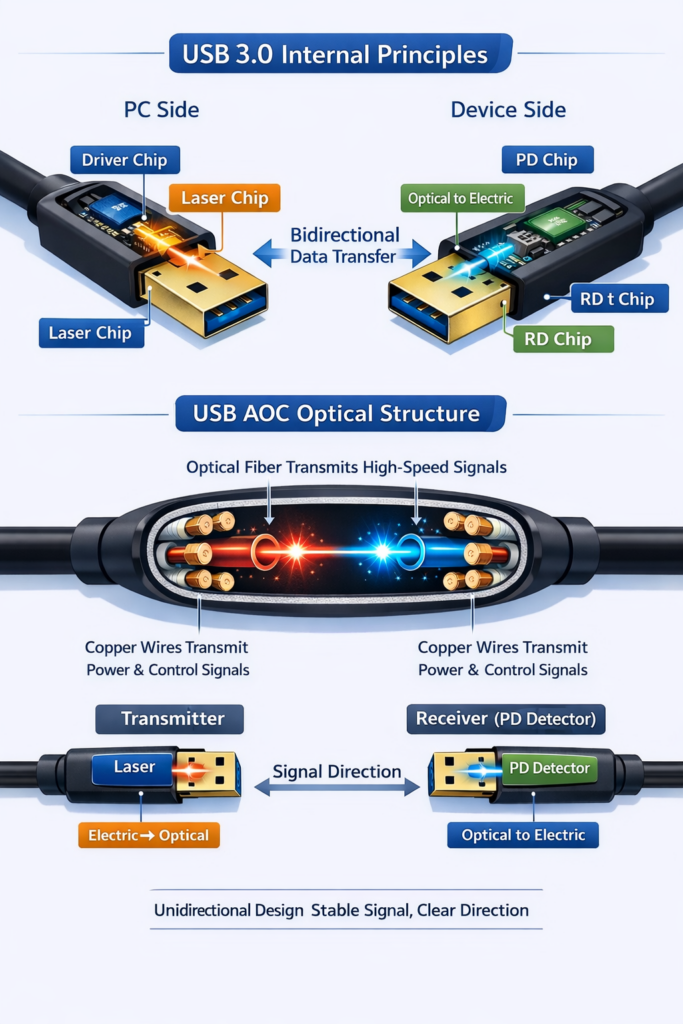
- On the computer-side connector, inside;
- On the device-side connector, inside.
They are not merely “simple metal contacts” but rather incorporate active components, mainly including:
Driver chip
Responsible for shaping, amplifying, and managing high-speed data signals.
Laser chip (Laser / VCSEL)
- Function: Converts electrical signals into optical signals.
- When data is sent from the host device, the electrical signals are converted into optical signals at this stage and then transmitted via optical fibers.
PD chip (photoelectric detector)
- Function: Converts light signals back into electrical signals.
- Used to receive light signals from the other end.
It is precisely because one end emits light while the other end receives it, and this process occurs in both directions simultaneously that USB 3.0 is able to achieve true two-way high-speed communication. This is also the fundamental reason why USB can transmit video/data while simultaneously performing control functions and providing feedback.
二、Why can USB AOC convert “copper wires” into “fiber optic transmission”?
In traditional USB 3.0 copper cables, high-speed signals are primarily transmitted through multiple pairs of differential copper wires. However, due to the relatively long distance between these wires, factors such as attenuation, crosstalk, and electromagnetic interference can rapidly increase. This is precisely why it is difficult for ordinary copper cables to maintain stable signal transmission over distances greater than 3 to 5 meters.
How does our USB AOC address this issue?
In the internal structure of a USB AOC:
- Two optical fibers are used in place of the original six high-speed copper wires.
- High-speed data is transmitted through these optical fibers, while low-speed control signals and power supply are still carried by copper wires.
The results of this design are:
✅ Extremely low signal attenuation.
✅ Almost no interference from electromagnetic fields.
✅ The device is lighter, thinner, and better suited for long-distance transmission.
This is precisely the reason why USB AOCs can achieve stable communication over distances of 10 meters, 15 meters, or even longer.
三、Why are some USB fiber optic cables “directional”?
This is one of the most frequently asked questions by customers.
The answer is quite simple:
It uses an active photoelectric conversion mechanism inside.
In our USB AOCs:
- One end is primarily responsible for converting electricity into light (transmission).
- The other end is primarily responsible for converting light back into electricity (reception).
When we are designing:
- We replace high-speed copper wires with optical fibers;
- And we add signal-enhancing chips on both sides of the copper wires, as needed.
Logically, this configuration results in the following: The signal transmission from port A to port B becomes more stable. In this way, the USB AOC design ensures a clear directionality of the signal. This is not a drawback, but rather an engineering decision made to achieve higher stability and longer transmission distances.
四、 If a certain function fails, can the entire USB cable still be used?
This is a genuine concern shared by many customers.
The answer is: it’s not necessarily the case that all of them will become ineffective.
This is because the USB cable itself operates in a multi-channel, multi-functional parallel manner.
- High-speed data (transmitted via fiber optic cables)
- Control signals (transmitted via copper wires)
- Power supply (VBUS, transmitted via copper wires)
Let’s take the most common example:
When a USB AOC cable is connected to a TV or display device:
- “Video signal abnormal.”
- “However, the device can still be charged normally.”
This is because the video/high-speed data channel and the power supply channel are physically and logically separate from each other. In other words:
✅ If there is an issue with just one part of the signal, it does not mean that the entire cable is “broken.”
This is precisely the advantage of the USB architecture itself, and it is also the reliability feature that we focused on maintaining when designing USB AOC
五、 Our core advantages in the design of USB AOC
As a manufacturer specializing in fiber optic cables, our approach to USB AOCs is not simply about replacing copper with fiber optics; rather, we design these products at the system level.
- Precise matching of the laser with the PD chip
- Optimization of the drive scheme based on distance and application scenarios
- Addition of signal-enhancing chips in necessary locations, rather than blind addition of components
- Preservation of critical copper trace functions to ensure proper power supply and compatibility
There is only one ultimate goal: to ensure that customers can use our products with confidence in applications that require long distances, high speeds, and high stability. For customers, the obvious desire is to use a cable for as long as possible. Even if certain functions of the cable eventually fail, it is still important that other functions remain operational – this is a factor that customers value very much.