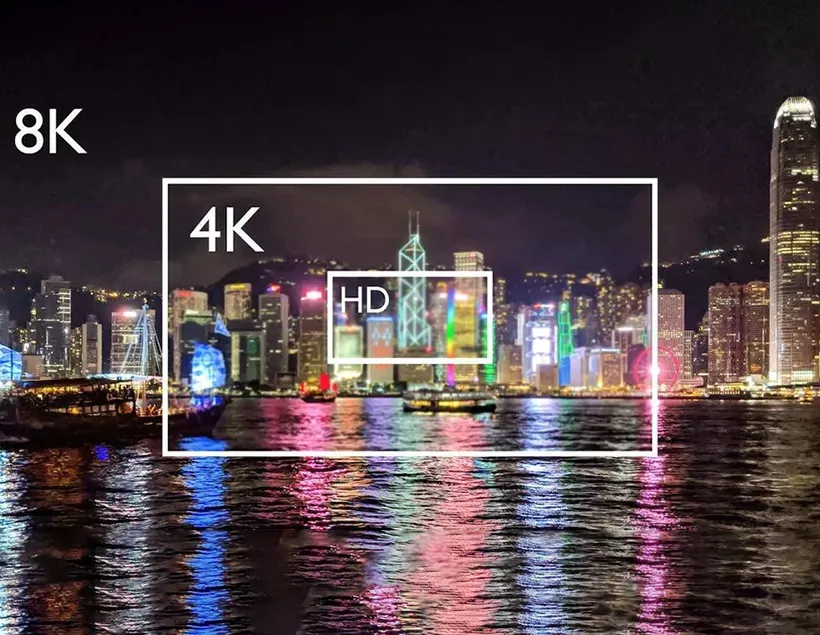
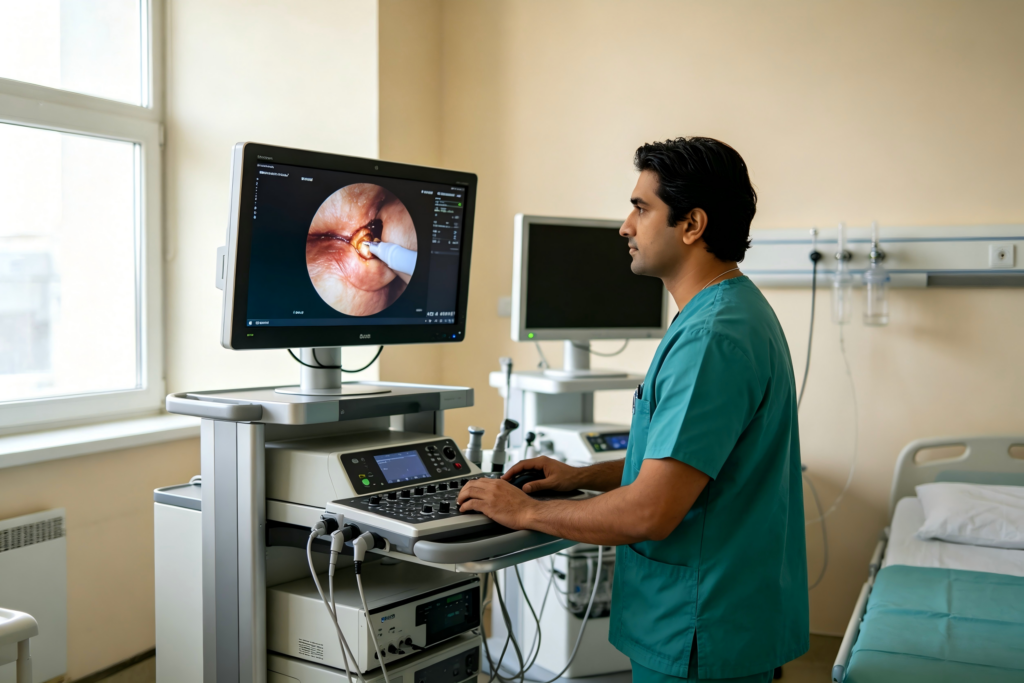
In the field of medicine, every technological advancement can represent a turning point for saving lives. When artificial intelligence begins assisting doctors in identifying lesions within megapixel-scale imaging, and when remote surgery requires near-zero latency between visual feedback and tactile response, data transmission is no longer just the movement of information—it becomes a critical lifeline that determines precision and efficiency.
It is in this context that USB 4 quietly enters operating rooms and diagnostic suites, acting as a “light-speed” bridge connecting imaging and intelligence.
Breaking the Distance Barrier: From Copper to Fiber
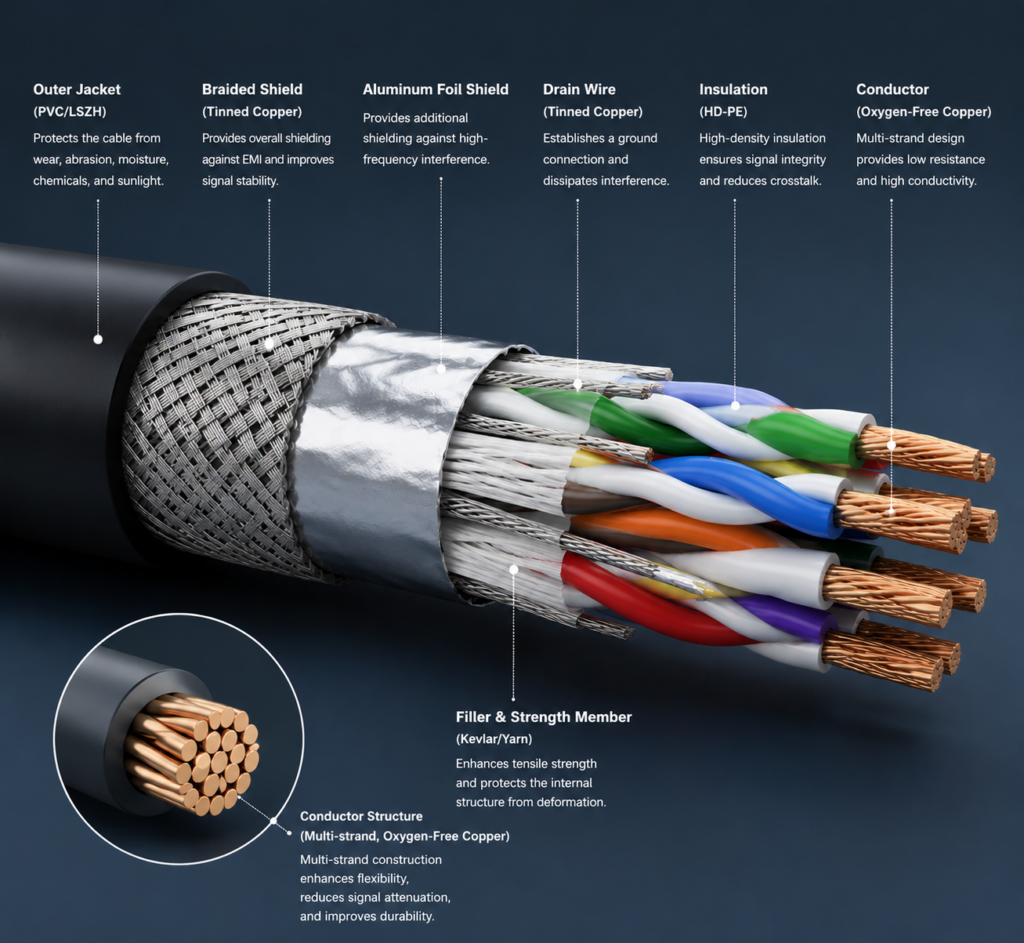
Traditional copper-based cables face fundamental physical limitations when transmitting high-speed signals over long distances. Signal attenuation and electromagnetic interference (EMI) become unavoidable challenges—especially in medical environments filled with sensitive electronic equipment.
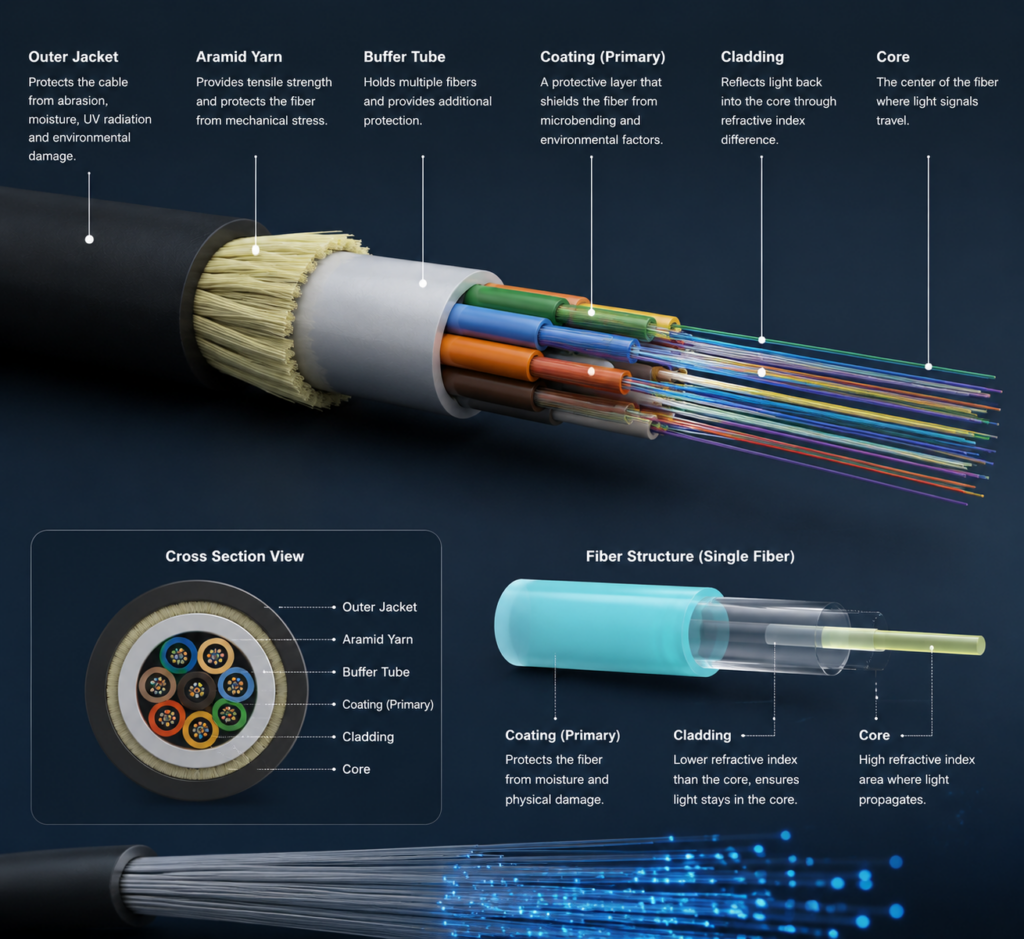
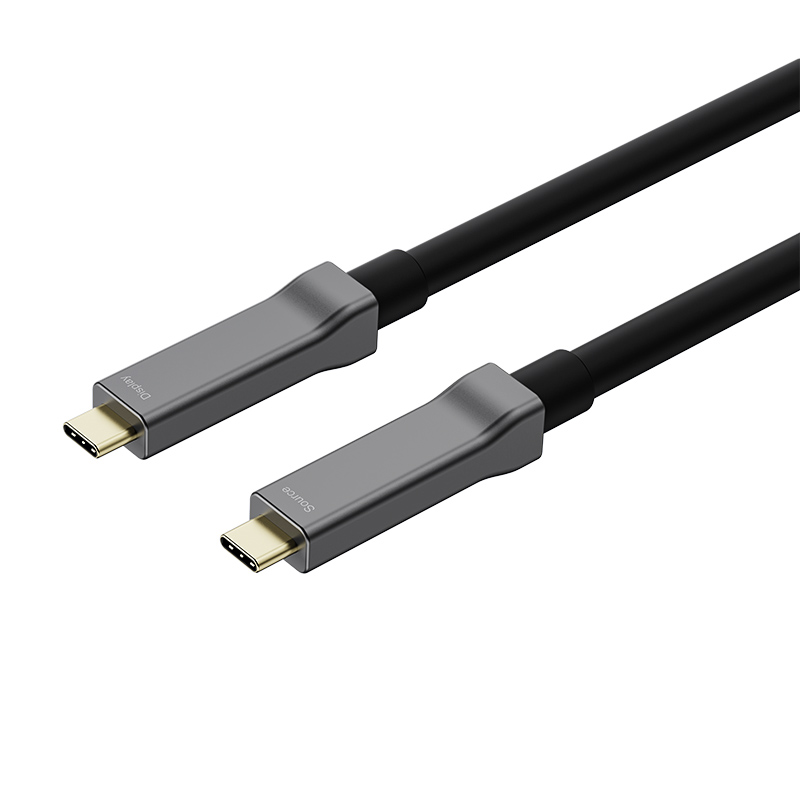
The introduction of USB 4 Active Optical Cable (AOC) replaces copper conductors with optical fiber as the transmission medium. This shift brings decisive advantages:
- Overcoming distance limits: Breaks the traditional 2–3 meter restriction of USB-C copper cables, enabling lossless, ultra-high-speed transmission over 30 meters or more.
- Immunity to interference: Completely resistant to EMI/RFI, ensuring clean and stable signals in complex hospital environments.
- Flexible equipment placement: High-value imaging systems no longer need to be placed beside the operating table, allowing cleaner and more ergonomic workflows.
As a result, doctors can access real-time, ultra-high-definition imaging from a distance, in a quieter and more organized environment.
A High-Speed Highway for Imaging and Computing
If optical fiber is the road, then USB 4 is the rule system governing a top-tier digital highway.
With up to 80Gbps bidirectional bandwidth, USB 4 Cable doubles the capacity of previous-generation standards, enabling major breakthroughs in medical imaging:
Ultra-High-Definition Imaging
USB 4 Cable supports DisplayPort Alt Mode tunneling, enabling stable transmission of 8K@60Hz and beyond, along with HDR10 high dynamic range imaging.
For endoscopy and surgical microscopy systems, this means:
- Clearer visualization of tissue texture and vascular structures
- Improved diagnostic accuracy
- More reliable real-time surgical guidance
Real-Time AI Diagnostic Acceleration
Modern medical imaging increasingly relies on AI-assisted analysis. Studies show that AI can increase polyp detection rates in colonoscopy to over 99%.
However, real-time AI requires massive data throughput:
- USB4’s integrated PCIe tunneling supports up to 40Gbps connectivity to external GPUs or AI accelerators
- Enables compact devices (e.g., portable ultrasound or endoscopic systems) to access powerful computing resources via a single cable
- Eliminates the need for bulky standalone computing units
Simplified and Reliable Connectivity
In operating rooms, cable complexity increases infection risk and operational difficulty.
USB4 Type-C integrates:
- High-speed data transmission
- 8K video output
- Up to 100W power delivery
This “3-in-1” architecture dramatically simplifies device setup, reduces equipment size, and improves mobility for emergency and field medicine.
The Foundation of Future Smart Healthcare
The true value of USB 4 Cable in healthcare lies in building a unified and open ecosystem.
- Fully backward compatible with USB 3.2, USB 2.0, and Thunderbolt 4/3
- Enables seamless integration of existing hospital equipment into high-speed systems
- USB4 v2.0 introduces asymmetric transmission modes, theoretically supporting up to 120Gbps downstream bandwidth
This provides a scalable foundation for future innovations such as:
- 16K ultra-high-resolution medical imaging
- More complex AI diagnostic models
- Fully remote robotic surgery systems
Ultimately, USB 4 solves the “last-mile” transmission bottleneck in medical digital transformation. It releases imaging data from the constraints of physical connections, enabling both human expertise and AI algorithms to make decisions based on complete, real-time information.
From compact AI-powered endoscopes to remote surgical robots, a more precise, intelligent, and reliable medical future powered by USB4 is rapidly becoming reality.
FAQ
1.What is the difference between USB4 and USB 3.2?
Key differences:
- Speed: USB4 supports up to 80Gbps, while USB 3.2 typically supports up to 20Gbps
- Architecture: USB4 uses protocol tunneling (PCIe + DisplayPort integration), USB 3.2 does not
- Video support: USB4 natively supports advanced display output like 8K via DisplayPort Alt Mode
- Efficiency: USB4 dynamically allocates bandwidth between data and video, improving overall performance
- Ecosystem: USB4 is more unified and closer to Thunderbolt-level functionality
In short: USB 3.2 is a fast data interface, while USB4 is a unified high-performance transport platform for data, video, and computing.
2.Why is USB4 important for medical imaging?
USB4 enables lossless transmission of ultra-high-definition medical images and supports real-time AI processing, which is critical for accurate diagnosis and surgical precision.
3.Can USB4 support remote surgery systems?
Yes. Its high bandwidth, low latency, and optical fiber implementation (via AOC) make it suitable for transmitting real-time imaging and control signals in remote surgical environments.
4.What is USB4 Active Optical Cable (AOC)?
USB4 AOC replaces copper wires with optical fiber, enabling longer transmission distances (30m+), higher stability, and immunity to electromagnetic interference.
5.Is USB4 backward compatible?
Yes. USB4 is fully backward compatible with USB 3.2, USB 2.0, and Thunderbolt 3/4 devices, ensuring smooth integration with existing hospital equipment.