Struggling with signal loss, flickering, or unstable transmission in large-scale naked-eye 3D LED display projects?
In modern shopping malls, DOOH advertising, and landmark digital installations, ultra-high resolution and long-distance signal transmission are no longer optional—they are critical. Traditional copper HDMI cables often fail beyond short distances, leading to black screens, signal drops, and costly on-site troubleshooting.HDMI 2.1 cables were thus developed to meet this demand.
Why HDMI 2.1 AOC is Essential for 3D LED Projects?
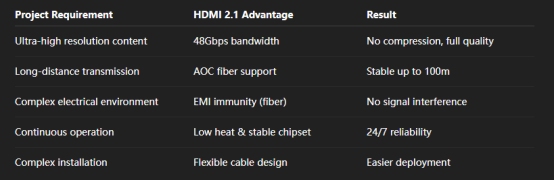
Naked-eye 3D displays demand more than standard AV connectivity. They require:
- Ultra-high bandwidth for non-standard resolutions
- Long-distance transmission between control room and LED processor
- Immunity to electromagnetic interference (EMI)
- Continuous 24/7 operation without signal degradation
Standard HDMI copper cables cannot meet these requirements reliably. HDMI 2.1 AOC fiber cables provide a future-proof and stable alternative.
Key Advantages of HDMI 2.1 in Naked-Eye 3D LED Displays
Naked-eye 3D LED displays demand extremely high bandwidth, ultra-smooth motion, and precise image rendering. HDMI 2.1 cables is specifically designed to meet these requirements, making it the preferred interface for high-end LED video wall projects.
Projects
Case Study – Naked-Eye 3D LED Display at Shenzhen MixC World
At 深圳万象天地, one of Shenzhen’s most high-profile commercial landmarks, the deployment of a large-scale naked-eye 3D LED display was not simply a visual upgrade, but a strategic move to transform the building façade into a high-impact digital attraction capable of capturing attention, increasing dwell time, and elevating brand value for both the mall and its advertising partners.
Unlike traditional LED installations, this project required not only ultra-high resolution and dynamic 3D rendering, but also a transmission system that could reliably handle massive data throughput over long distances in a complex, interference-heavy commercial environment.
End-to-End Workflow Explanation
Step 1 – High-Resolution 3D Content Output
The process begins with a high-performance media server equipped with advanced GPUs, where custom naked-eye 3D content is rendered in ultra-wide or non-standard resolutions such as 7680×2160 or higher, requiring extremely high data throughput and precise frame synchronization to maintain visual consistency across the LED surface.
Because such content often exceeds the limits of traditional transmission standards, HDMI 2.1 becomes essential, as it allows the system to output uncompressed video at up to 48Gbps, ensuring that every frame retains its full detail and depth without compromise.
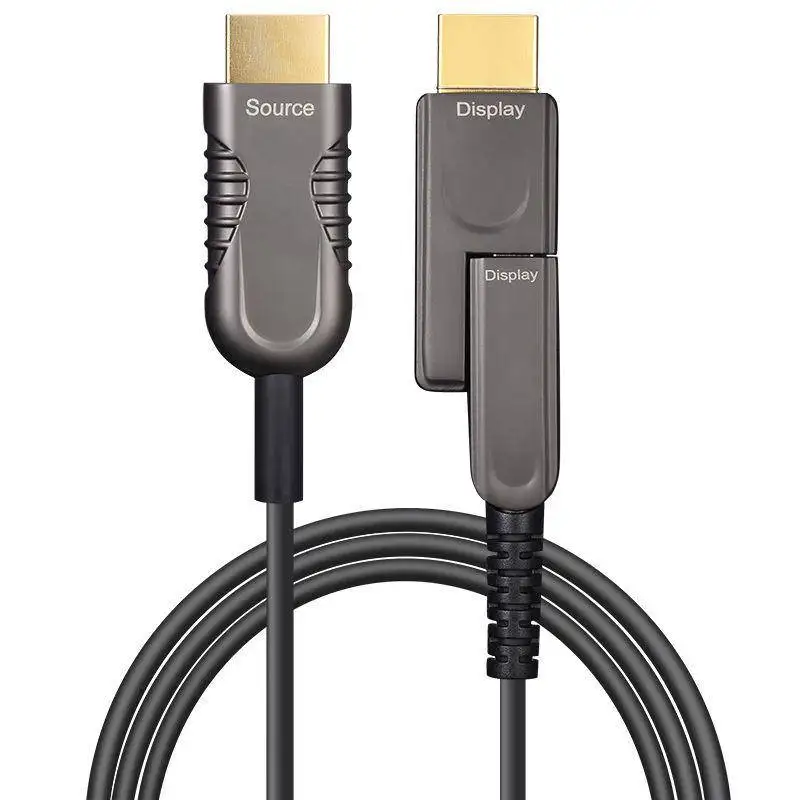
Step 2 – Long-Distance Signal Transmission (Where HDMI Fiber Matters Most)
In a real commercial environment like 深圳万象天地, the media server is typically located in a dedicated control room, often separated from the LED façade by distances ranging from 30 to 80 meters, while also being surrounded by electrical systems such as elevators, HVAC units, and power distribution infrastructure that introduce significant electromagnetic interference.
At this stage, the HDMI 2.1 AOC fiber cable plays a decisive role, as it converts electrical signals into optical signals for transmission, effectively eliminating signal attenuation and interference over long distances, while maintaining full bandwidth and zero latency, something that traditional copper HDMI cables simply cannot achieve beyond short ranges.
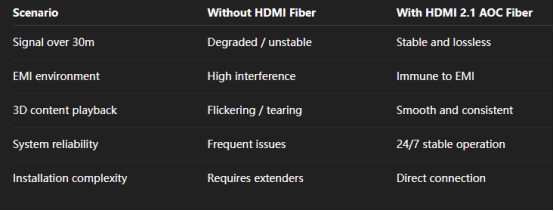
Without fiber-based transmission, the system would be highly susceptible to flickering, signal drops, or even complete failure, especially under continuous 24/7 operation.
Step 3 – Video Processing and Signal Mapping
Once the signal reaches the video processor, it undergoes real-time scaling, mapping, and synchronization to match the unique geometry and resolution of the LED display, which is often non-standard and requires precise pixel-level alignment to achieve the naked-eye 3D illusion.
Because this stage relies heavily on a clean and stable input signal, any instability in the HDMI link—such as jitter, attenuation, or interference—would immediately translate into visible defects on the screen, including tearing, misalignment, or frame drops.
By ensuring a stable and interference-free signal, the HDMI fiber cable effectively guarantees that the processor can operate at full performance without error.
Step 4 – Signal Distribution to LED Modules
After processing, the signal is converted into LED-specific data formats and distributed via Ethernet or optical links to receiving cards embedded within each LED panel, allowing synchronized playback across the entire display surface.
At this point, HDMI is no longer part of the transmission chain; however, its role in the earlier stage remains critical, as any issue before this point cannot be corrected downstream.
Step 5 – Final Display Output
The final result is a seamless naked-eye 3D visual experience, where ultra-high-resolution content, precise perspective rendering, and smooth motion combine to create a highly immersive illusion that appears to extend beyond the physical boundaries of the screen.
This level of performance is only possible when the entire signal chain is stable, with HDMI fiber transmission ensuring that no data is lost, delayed, or distorted along the way.
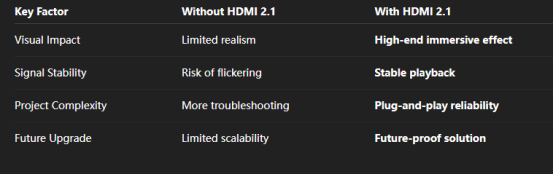
Engineering Comparison – With vs Without HDMI Fiber
Project Outcome
Following the implementation of HDMI 2.1 AOC fiber transmission, the project achieved not only a visually stunning naked-eye 3D effect that significantly increased foot traffic and audience engagement, but also a highly stable system capable of continuous operation without signal-related failures, thereby reducing maintenance costs and ensuring long-term reliability for both the mall and its advertising clients.
Key Insight for System Integrators
In large-scale commercial projects like 深圳万象天地, the success of a naked-eye 3D LED display does not depend solely on the screen or the content itself, but fundamentally on the stability of the signal transmission system, where HDMI 2.1 AOC fiber cables serve as the backbone that enables high bandwidth, long-distance, and interference-free performance.
FAQ
Q1: Why does my LED video wall flicker when using HDMI?
Flickering is usually caused by insufficient bandwidth or signal degradation over distance. HDMI 2.1 AOC cables provide full bandwidth and stable transmission.
Q2: Can active HDMI cables run 4K over 50 meters?
Traditional copper HDMI cables cannot. Active optical HDMI cables can easily support 50m–100m without signal loss.
Q3: Why are active HDMI cables directional?
Because they contain active optical modules. The “Source” end must be connected to the signal output device, and the “Display” end to the receiving device.
Q4: Will this cable work with LED video processors?
Yes, it is compatible with most mainstream video processors and graphics cards.
Get a Reliable HDMI Solution for Your 3D LED Project,Avoid costly signal issues and installation failures.
Smartavlink is trusted by system integrators and engineers for high-performance LED display projects.
Contact us today for:
- Project consultation
- Custom cable lengths
- OEM / ODM support
info@elikecorp.com https://elikecorp.com
info@smartavlink.com