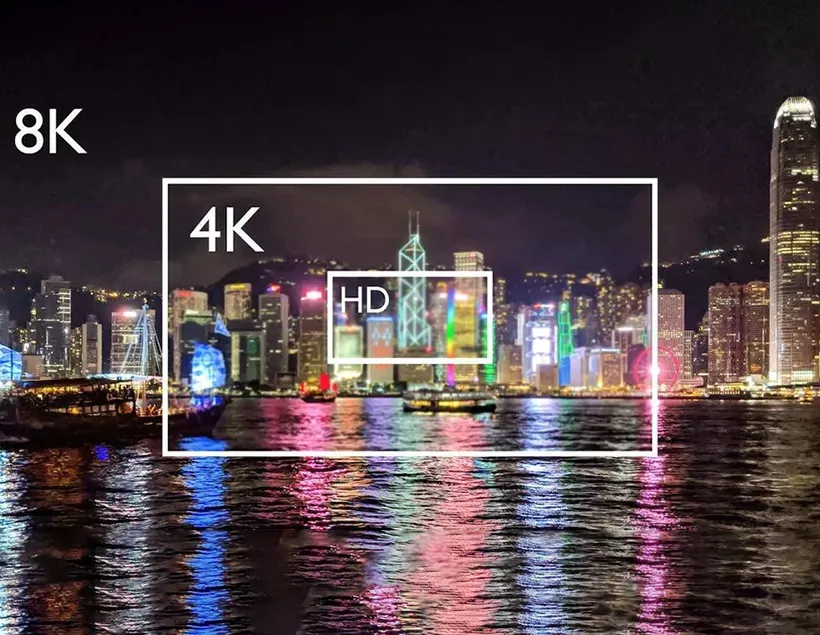
What Is a Mini HDMI to Mini HDMI Cable and Why It Matters
A Mini HDMI to Mini HDMI cable is a video and audio transmission cable with Mini HDMI (Type-C) connectors on both ends, designed to directly connect two devices that share the same compact HDMI interface. This cable is commonly used with digital cameras, camcorders, portable monitors, embedded systems, and other compact multimedia equipment.
Unlike standard HDMI cables used for TVs and desktop displays, Mini HDMI cables focus on space-saving design without sacrificing signal quality. For users working with portable imaging devices or professional field equipment, this cable provides a reliable and straightforward connection method.
From an SEO and user-intent perspective, many customers search for this cable when they:
- Need a direct camera-to-monitor connection
- Want to avoid bulky adapters or converters
- Require stable high-definition video output for recording or live preview
- Work in mobile, studio, or industrial environments where compact cabling is essential
Customer Pain Points Solved by a Mini HDMI to Mini HDMI Cable
Choosing the right cable is often driven by real-world challenges. A high-quality Mini HDMI cable helps solve several common problems:
1. Eliminating Adapter Instability
Adapters can loosen over time, causing signal drops or flickering. A single-piece Mini HDMI cable removes extra connection points, improving long-term reliability.
2. Supporting High-Resolution Imaging Workflows
Modern cameras capture Full HD and 4K video, which requires consistent bandwidth and shielding. Professionally manufactured cables ensure smooth, loss-free transmission for monitoring, recording, or broadcasting.
3. Improving Portability and Cable Management
Photographers, videographers, and field engineers often operate in tight spaces. The compact Type-C connector keeps setups lightweight and organized.
4. Ensuring Plug-and-Play Convenience
No drivers, software, or external power are needed. Users can connect devices instantly and begin transmitting audio and video signals.
How a Mini HDMI to Mini HDMI Cable Works Internally
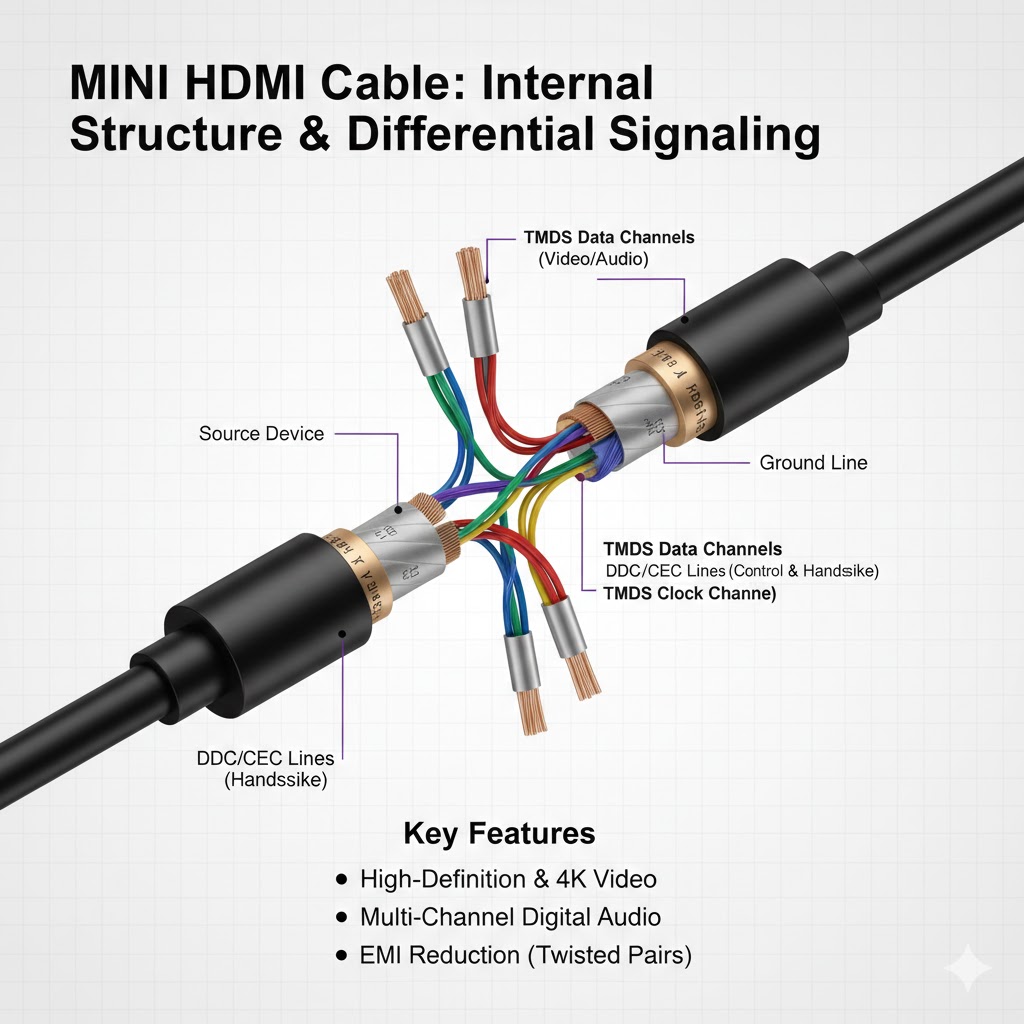
Although simple on the outside, the internal structure of a Mini HDMI to Mini HDMI cable is carefully engineered for high-speed digital transmission.
Differential Signaling for Stable Data Transfer
HDMI uses TMDS (Transition-Minimized Differential Signaling) to send video, audio, and clock data across multiple twisted pairs. This design reduces electromagnetic interference and preserves signal integrity.
Multi-Channel Transmission
Inside the cable are:
- Three high-speed data channels for video and audio
- One clock channel for synchronization
- Shielding layers to block external interference
- Ground and control lines for device communication (CEC, EDID, etc.)
This architecture allows the cable to deliver:
- High-definition and 4K resolution video
- Multi-channel digital audio
- Real-time, low-latency signal output
Because both ends use the same Mini HDMI interface, no signal conversion is required, ensuring maximum efficiency and minimal latency.
Differences Between Mini HDMI to Mini HDMI and Other HDMI Cable Types
Understanding how this cable compares to other HDMI formats helps buyers choose correctly.
Connector Size and Device Compatibility
- Standard HDMI (Type-A): TVs, PCs, gaming consoles
- Mini HDMI (Type-C): Cameras, tablets, portable monitors
- Micro HDMI (Type-D): Action cameras, ultra-compact devices
A Mini HDMIcable is specifically built for Type-C to Type-C connections, making it ideal for professional imaging and embedded display systems.
No Signal Conversion Required
Cables like HDMI to DisplayPort require active chipsets.
Mini HDMI to Mini HDMI is pure digital pass-through, resulting in:
- Lower latency
- Higher reliability
- Reduced power consumption
Portability Advantage
Compared with thick, long HDMI cables used in home theaters, Mini HDMI cables are:
- Thinner and lighter
- Easier to route in rigs or control boxes
- Better suited for mobile production environments
Key Application Scenarios for Mini HDMI to Mini HDMI Cables
Because of their compact design and stable performance, these cables are widely used across multiple industries.
Photography and Videography
- Connecting DSLR or mirrorless cameras to field monitors
- Real-time video preview during filming
- External recording and live streaming setups
Professional AV and Broadcasting
- Portable production kits
- Studio monitoring systems
- Embedded display control equipment
Industrial and Embedded Systems
- Machine vision displays
- Testing instruments with Mini HDMI ports
- Control panels and compact computing devices
Education and Research
- Laboratory imaging systems
- Portable teaching displays
- Technical demonstration equipment
These diverse applications highlight the cable’s flexibility, durability, and signal stability.
Choosing a High-Quality Mini HDMI to Mini HDMI Cable
For long-term performance, buyers should consider:
- 4K or higher resolution support
- Strong EMI shielding and twisted-pair design
- Durable connector molding and strain relief
- Certified RoHS, CE, or FCC compliance
- Optional OEM/ODM customization for professional projects
A well-engineered cable ensures consistent signal transmission and extended service life, especially in demanding environments.
Conclusion
A Mini HDMI to Mini HDMI cable is more than a simple connector—it is a reliable bridge for high-definition audio and video between compact devices. By eliminating adapters, maintaining signal integrity, and supporting modern imaging workflows, this cable addresses key user pain points across photography, broadcasting, industrial control, and portable AV systems.
As high-resolution content and mobile production continue to grow, dependable Mini HDMI connectivity will remain essential. Selecting a certified, high-performance cable ensures stable operation today while preparing systems for future display requirements.