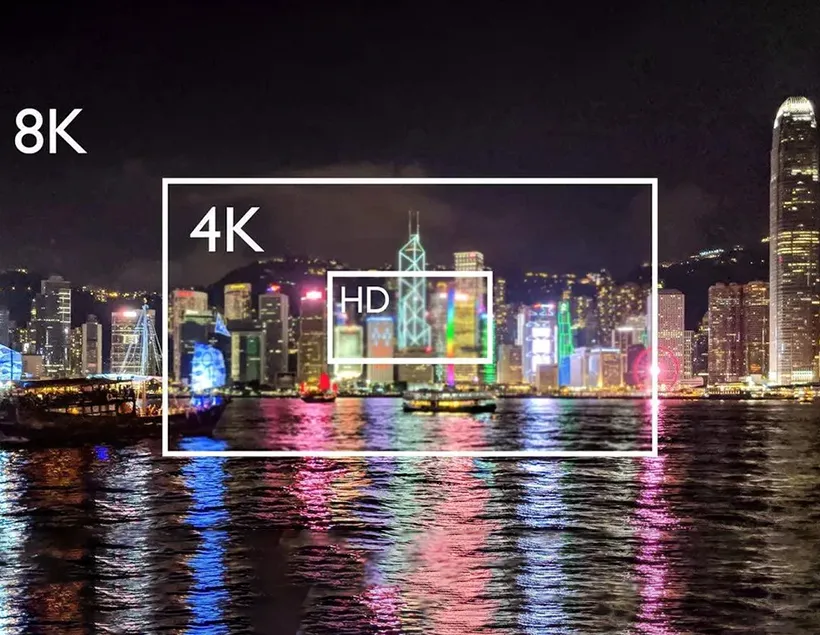
As USB interfaces evolve toward higher data rates, greater power delivery, and higher video resolutions, cables must carry high-speed data, audio and video signals, and power within a limited diameter. Conventional twisted-pair cables are more susceptible to signal attenuation, crosstalk, and electromagnetic interference at high frequencies and over longer distances. With individual shielding and a stable impedance structure, micro-coaxial cables provide a more reliable connection for USB 3.2 and USB 4.0 cable.
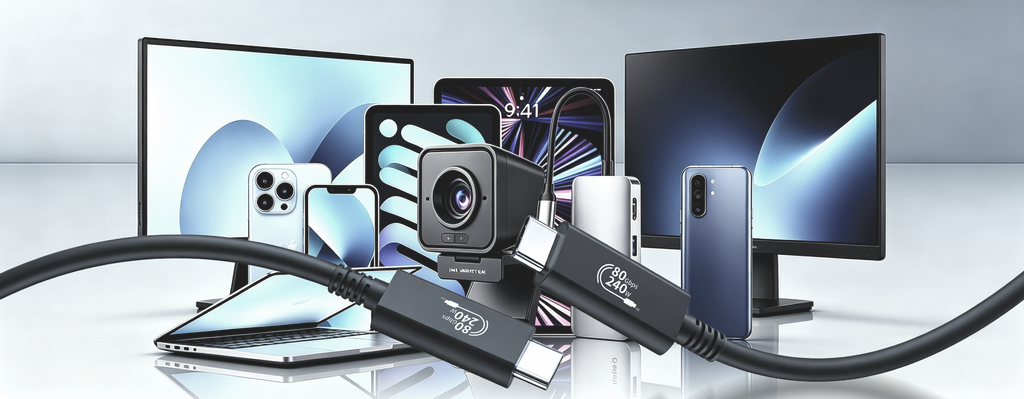
What Is a USB Micro-Coaxial Cable?
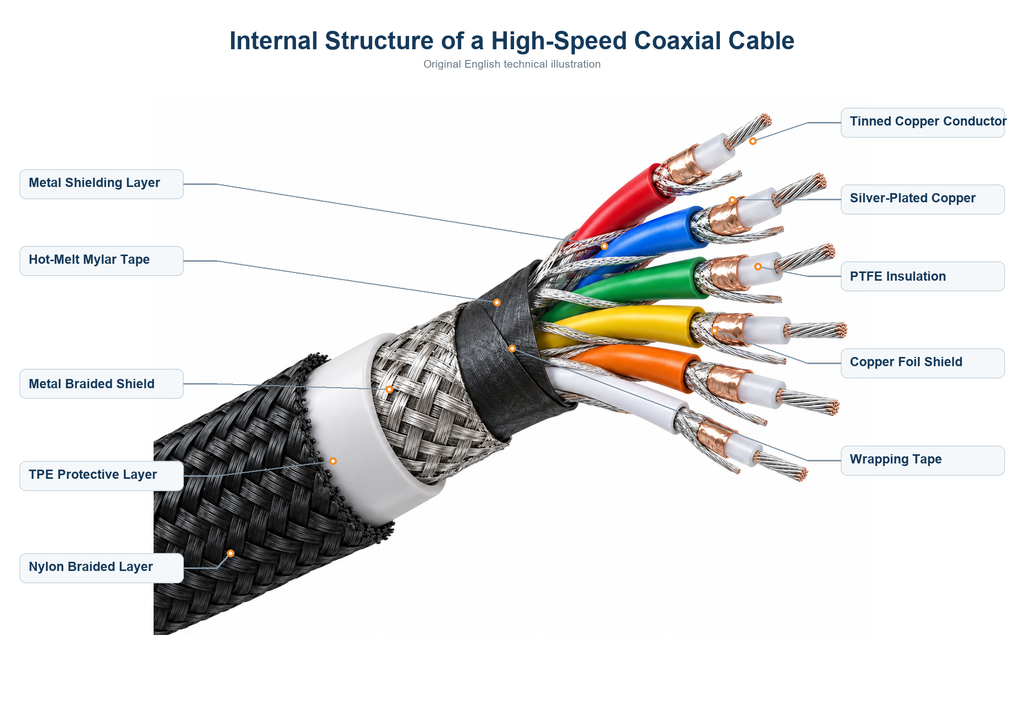
A micro-coaxial cable consists of a central copper conductor, dielectric insulation, a metallic shield, and an outer jacket. High-speed signals travel between the central conductor and the shield, while the electromagnetic field is largely confined within the dielectric. This reduces outward signal radiation and limits the effect of the surrounding electromagnetic environment on transmission.
USB micro-coaxial cables commonly use polytetrafluoroethylene (PTFE) as the insulating material. PTFE forms the internal dielectric layer between the center conductor and the outer shield and is a key material in high-end active USB coaxial and RF coaxial cables. Its low dielectric loss helps reduce high-frequency signal attenuation and maintain a stable characteristic impedance.
Conventional twisted-pair cables control differential signals through the twisting of two conductors. Manufacturing variations, bending, and changes in pair spacing can all affect impedance consistency. A micro-coaxial cable has a more uniform geometry, and each high-speed signal channel can have its own shield, making the construction better suited to high-frequency, high-bandwidth connections.
Key Advantages of Micro-Coaxial Cables
Lower High-Frequency Signal Loss
High-speed signals attenuate as they travel farther through copper conductors. Micro-coaxial cables use low-loss insulation and a stable coaxial structure to reduce the loss of high-frequency components, helping data and video signals remain intact over longer distances.
Stronger Interference Immunity
The metallic shield in a coaxial cable surrounds the center conductor and reduces the effect of external EMI and RFI on the signal. In conference rooms, equipment rooms, industrial systems, and other electromagnetically complex environments, this structure helps reduce the risk of image artifacts, data errors, and connection interruptions.
Lower Channel Crosstalk
High-speed USB cables contain multiple signal channels. Conventional twisted pairs can affect one another during high-frequency operation, whereas micro-coaxial cables can provide separate shielding for individual high-speed channels, reducing crosstalk between channels.
More Stable Impedance Control
The stable geometry of a coaxial structure makes characteristic impedance easier to control. Continuous impedance reduces signal reflections in the connection path, improves eye-diagram quality, and lowers the risk of bit errors during high-speed data transmission.
Lighter, Thinner, and More Flexible
Micro-coaxial construction can reduce cable diameter while maintaining high-speed performance. Some USB 3.2 Gen 2×2 micro-coaxial products have a diameter of approximately 2.7 mm, making them suitable for AR glasses, portable monitors, high-speed cameras, and other devices with demanding weight and bending requirements.
Differences Between Coaxial and Conventional Copper Cables
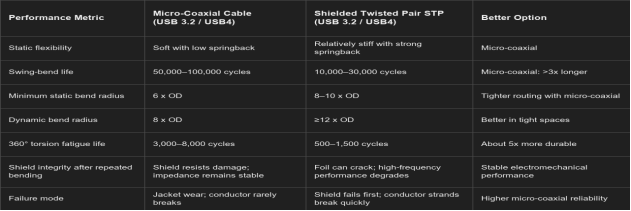
From the center outward, a coaxial cable consists of a copper conductor, PTFE insulation, a braided metallic shield, and an outer jacket. This coaxial structure effectively isolates external electromagnetic interference. A conventional twisted-pair copper cable uses two insulated copper conductors twisted at a specified rate so that the electromagnetic fields of the pair cancel and reduce interference. Twisted-pair cables are available in shielded (STP) and unshielded (UTP) versions.
How Do Active Coaxial Cables Extend Transmission Distance?
As cable length increases, high-speed signals experience attenuation, noise, and clock jitter. Active coaxial cables integrate a Redriver or Retimer chip inside the connector to compensate for signal degradation.
A Redriver is an analog signal processor that primarily compensates for high-frequency attenuation through equalization and gain. It strengthens the original signal but does not recover the clock and data, so existing noise and jitter may remain.
A Retimer uses clock and data recovery circuitry to recognize the data sequence and then retransmits a reshaped signal using a new clock. Compared with a Redriver, a Retimer is better suited to USB4, longer connections, and equipment with stricter signal-integrity requirements.
Elike active coaxial products use a Retimer solution. The cable powers its internal chip through the USB interface and requires no external power supply. Some active cables have clearly designated Source and Device ends and must be installed according to the directional markings.
Data, Video, and Power Through One Cable
Depending on the model, a USB-C coaxial cable can carry high-speed data, video signals, and USB Power Delivery simultaneously. A single cable can connect a laptop, monitor, docking station, mobile device, or professional imaging device, reducing the number of interfaces and cables required.
The Elike coaxial product family covers multiple performance levels:
USB 4 Active Retimer Coaxial Cable
This series supports data transfer rates up to 40 Gbps, USB PD charging up to 100 W, and video output up to 4K at 60 Hz, with lengths up to 3 m. Built-in Retimer and E-Marker chips make it suitable for computers, monitors, docking stations, and high-speed storage devices.
USB 4 40 Gbps and 80 Gbps Coaxial Cables
This series is available in 40 Gbps and 80 Gbps versions and supports USB PD charging up to 240 W and video output up to 8K at 60 Hz, with lengths of approximately 2.5 m. It is suitable for high-performance workstations, high-resolution displays, and high-power USB-C devices.
USB 3.2 Gen 2×2 Micro-Coaxial Cable
The micro-coaxial version supports data rates up to 20 Gbps and video output up to 4K at 60 Hz. The 0.5 m and 1 m versions support power delivery up to 100 W, while the 1.5 m version supports up to 60 W. With a cable diameter of approximately 2.7 mm, it is suitable for AR glasses, high-speed cameras, and portable devices.
USB 3.2 Active Coaxial Cable
The active version supports data rates up to 10 Gbps, power delivery up to 100 W, and video output up to 4K at 60 Hz, with lengths up to 5 m. Built-in Retimer and E-Marker chips make it suitable for televisions, cameras, and computers that require longer connection distances.
USB 3.2 Gen 2×2 Coaxial Cable
This series supports data rates up to 20 Gbps, power delivery up to 100 W, and video output up to 4K at 60 Hz, with versions available in lengths up to 5 m. Its coaxial construction is suitable for display equipment, imaging equipment, and fixed-installation systems.
Typical Applications
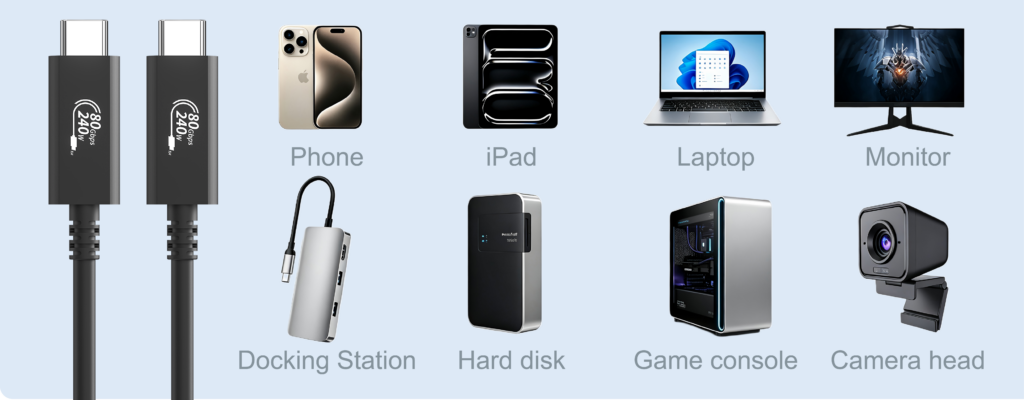
USB micro-coaxial cables can be used with the following equipment and systems:
- Connections between laptops, monitors, and docking stations
- High-speed portable hard drives, SSDs, and other storage devices
- AR glasses, VR devices, and portable monitors
- Industrial cameras, high-speed cameras, and image-acquisition equipment
- Conference-room video equipment and commercial display systems
- Televisions, projectors, and home entertainment equipment
- Data transfer among smartphones, tablets, and computers
- Industrial equipment, in-vehicle equipment, and space-constrained embedded devices
Which Parameters Should Be Checked When Selecting a Cable?
First, determine the data bandwidth required by the device. A 10 Gbps version is suitable for common peripherals, while high-speed storage and professional equipment may require a 20 Gbps, 40 Gbps, or 80 Gbps version.
Next, confirm the required video resolution and refresh rate. If the cable will be used for a display connection, verify that the host, cable, and display all support 4K at 60 Hz or 8K at 60 Hz.
Power requirements must also be checked separately. Different models support 60 W, 100 W, or 240 W. Actual power delivery depends on the USB PD profiles supported by the charger, host, cable, and connected device.
For connections beyond the effective range of a conventional passive cable, choose an active model with a built-in Retimer. When using an active cable, also check the required connection direction and port markings.
Conclusion
Through low-loss insulation, individual shielding, and a stable impedance structure, micro-coaxial cables improve signal integrity in high-speed USB connections. They reduce high-frequency attenuation, channel crosstalk, and external electromagnetic interference while maintaining a small diameter and good flexibility.
When combined with Retimer and E-Marker chips, coaxial cables can also support longer-distance data transmission, high-resolution video output, and high-power USB PD, providing a more stable connection for USB 3.2 and USB4 devices.