When high-resolution cameras, storage devices, VR systems, and industrial equipment move more data than a conventional USB cable can reliably carry over distance, a faster connector alone is not enough. The complete link must preserve speed, resist interference, protect connected ports, and remain practical in daily use. That is the problem the new Elike SVRC-3120 Active Optical USB 3.2 Gen 2 Cable is designed to solve.
The SVRC-3120 combines OM3 optical fiber with copper conductors in a slim USB-C cable. It delivers data at up to 10Gbps over lengths of up to 10 meters, supports up to 60W Power Delivery, and uses identical USB-C connectors for true bidirectional operation. The result is a lightweight, plug-and-play connection for demanding professional environments where standard copper cabling may become too short, bulky, or vulnerable to electromagnetic interference.
USB 3.2 Gen 2 is a USB data standard capable of a theoretical transfer rate of 10Gbps. It is often described as SuperSpeed USB 10Gbps and offers twice the bandwidth of a 5Gbps USB connection. In practical terms, the additional bandwidth helps large RAW photo files, production assets, backups, and high-volume device data move more quickly between compatible USB devices.
What Is USB 3.2 Gen 2?
However, the USB version describes the protocol and maximum link speed; it does not guarantee that every cable will perform equally well at every length. Passive copper cables become more difficult to engineer as speed and distance increase.
The SVRC-3120 addresses this limitation by converting high-speed electrical data into optical signals inside the cable, carrying those signals through fiber, and converting them back at the receiving end.
It is also important to distinguish USB 3.2 Gen 2 from USB4 and Thunderbolt. The SVRC-3120 is built for USB 3.2 data and is backward compatible with USB 2.0 and USB 1.1. It is not a Thunderbolt cable, cannot read USB4 external drives that require a USB4 link, and does not carry DisplayPort Alt Mode or other video signals.
Why the SVRC-3120 Uses a Hybrid Optical Design
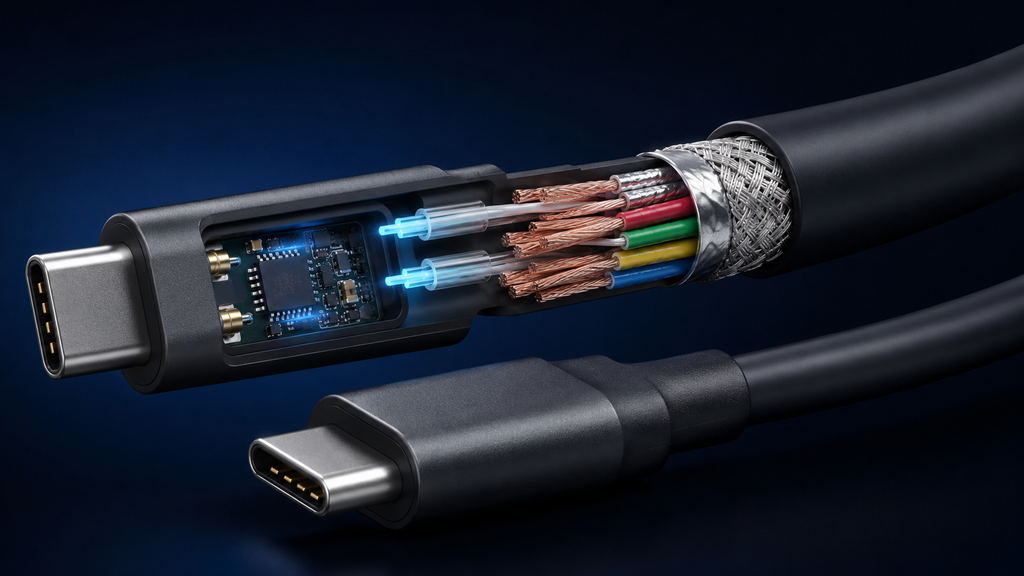
Inside the cable, two OM3 multimode fibers carry the high-speed USB 3.2 Gen 2 data stream. An 850nm VCSEL optical engine and PIN photodetector handle electro-optical conversion, while copper conductors remain available for USB 2.0 communication, control functions, and power. This hybrid architecture allows the cable to combine the distance and interference resistance of fiber with the power-handling capability of copper.
Because optical fiber does not conduct electromagnetic noise in the same way as copper signal paths, the cable offers strong EMI and RFI resistance. That is valuable around studio lighting, industrial machinery, server equipment, and other electrically noisy systems. The optical path also carries the high-speed data without compression, helping preserve the integrity of files transferred through the connection.
Key Advantages
Stable 10Gbps Data Over Longer Distances
The SVRC-3120 is available in standard 5-meter, 7.5-meter, and 10-meter lengths, with custom lengths available for project requirements. This extended reach allows a workstation, camera, storage dock, conference system, or machine-vision computer to be positioned where it makes sense operationally rather than where a short passive cable permits.
True Bidirectional USB-C Connectivity
Many active optical cables mark one connector as the host end and the other as the device end. The SVRC-3120 removes that installation step. Its two USB-C ends are functionally identical, so users do not need to identify a source and display direction before connecting equipment. This makes setup faster and reduces troubleshooting when cables are installed through furniture, studio rigs, or equipment racks.
Up to 60W Power Delivery
The hybrid construction supports up to 60W PD, allowing power and high-speed data to share one cable when the connected devices and power source support the required USB-C charging profile. For tethered photography, mobile workstations, and compatible peripherals, this can reduce battery interruptions and eliminate a separate data cable. No external power supply is required to operate the active cable itself.
Port-Friendly Connector Options
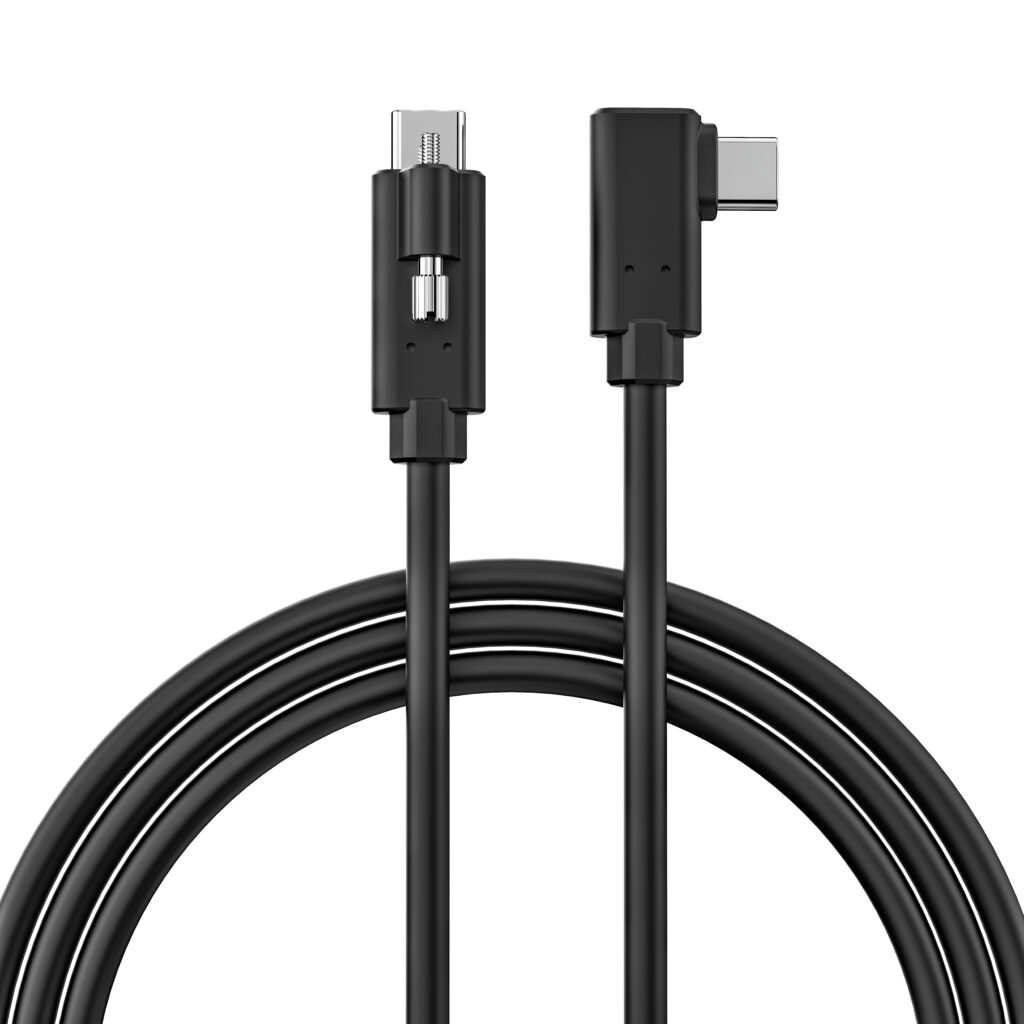
A 90-degree right-angle connector allows the cable to follow the side of a camera or device instead of projecting straight outward. This reduces leverage on the USB-C port, lowers the chance of accidental disconnection, and makes installation easier in tight spaces. Screw-lock connector and alternative molded-shell options are also available for applications that need additional retention or a customized mechanical design.
Lightweight but Mechanically Protected
With an outer diameter of approximately 5.0mm, the cable is designed to remain manageable for camera movement and VR or AR use. Internally, double-layer shielding and gold-plated contacts support long-term connection reliability. The published mechanical ratings include 200N tensile strength, 100N crush resistance, and a 50mm minimum bend radius, although actual installation limits should always account for the connected devices and routing conditions.
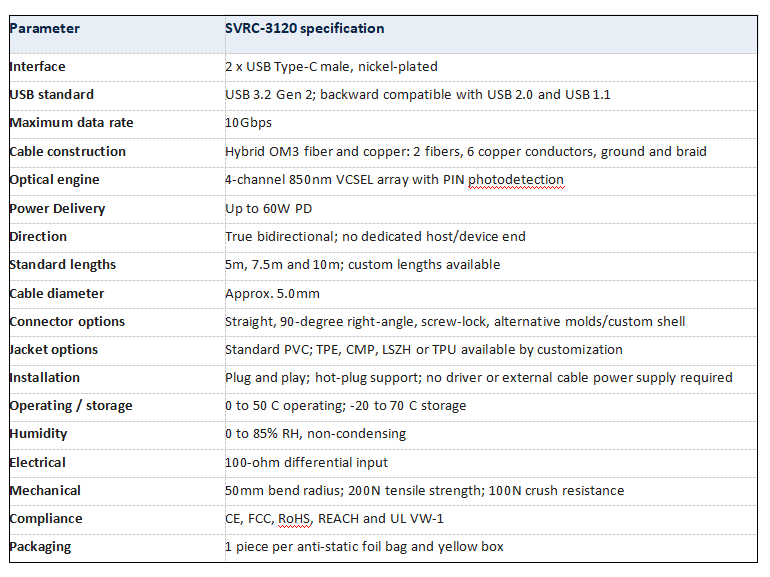
SVRC-3120 Technical Specifications
The following specifications summarize the product configuration. In an installation, final performance also depends on the host, peripheral, charger, and USB protocol supported by each connected device.
Professional Application Scenarios
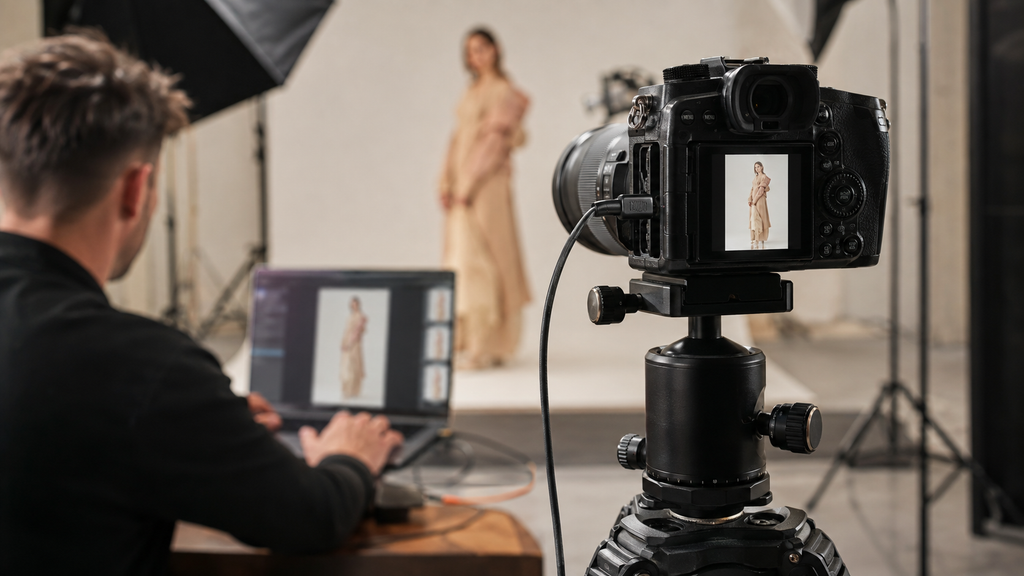
Tethered Photography and Professional Imaging
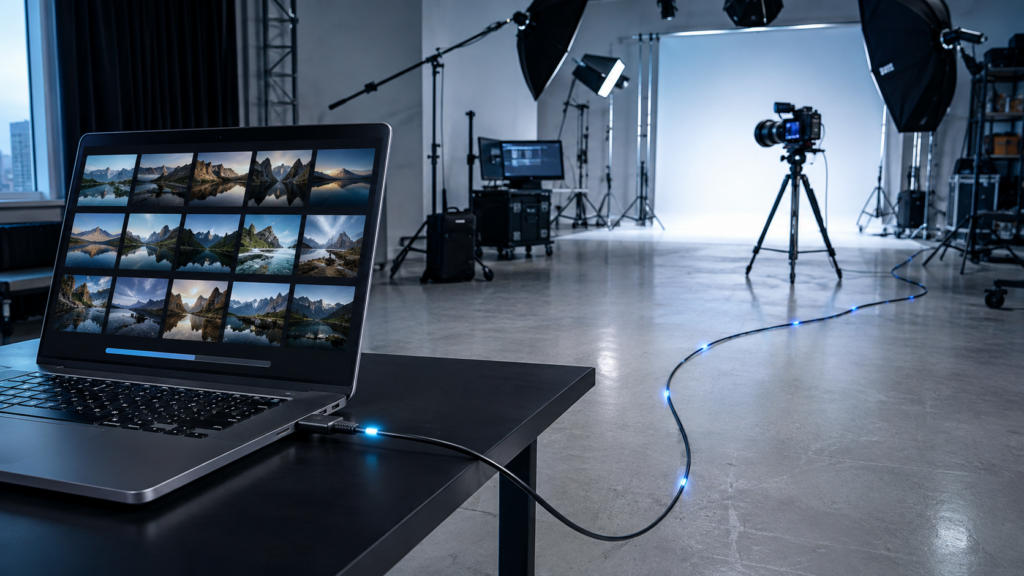
High-resolution mirrorless and DSLR cameras can generate large RAW files continuously. A 10Gbps link helps images appear at the workstation with less waiting, while optical transmission resists interference from studio equipment. The right-angle connector also routes neatly along a camera cage or body and reduces stress on the camera port during long sessions.
Data Storage and High-Speed File Transfer
The cable can connect compatible USB 3.2 storage devices, HDD docks, and workstations across a room, editing suite, or equipment bay. It is intended for USB 3.2 storage workflows; a USB4-only external drive that requires a USB4 connection is not supported.
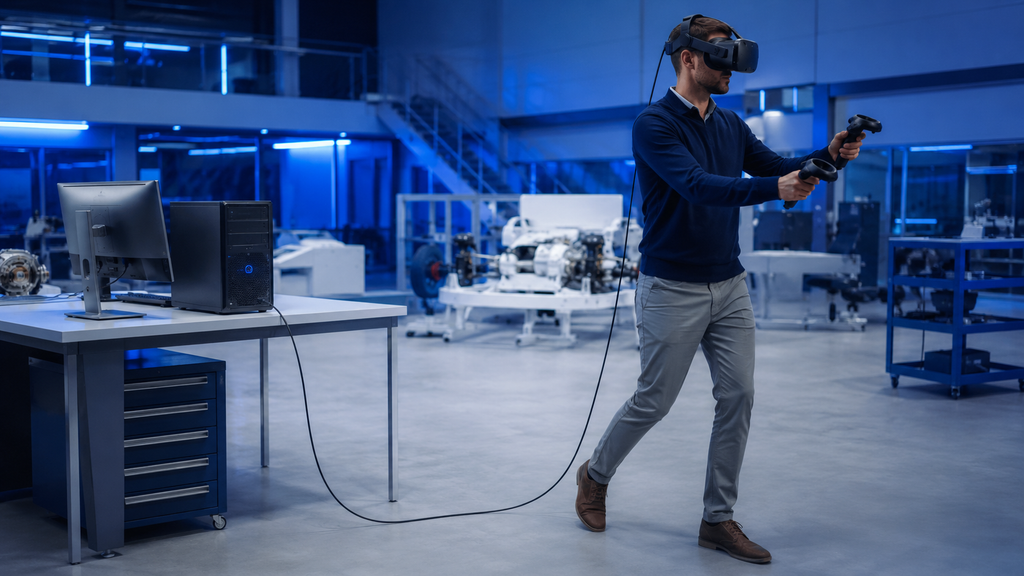
VR and AR Systems
A thin, lightweight cable is easier to route around a headset or training area than a heavy long copper cable. The extended reach can support room-scale professional setups, while 60W PD may provide power to compatible equipment. The application must use USB data only because this model does not transmit video.
Machine Vision and Industrial Equipment
Factories and inspection systems often place cameras or sensors several meters from the processing computer and close to motors or other sources of electrical noise. The SVRC-3120 offers long USB data reach, strong EMI resistance, screw-lock options, and customizable jacket materials for more secure integration into machine-vision and industrial installations.
Video Conferencing, Collaboration, and Smart Education
Conference rooms and training spaces frequently require USB cameras or other peripherals to be separated from the main computer. A 5- to 10-meter optical USB connection gives integrators more freedom to position equipment while maintaining a clean, driver-free connection. Here, “video conferencing” refers to USB data from compatible conferencing peripherals; the cable itself does not carry a native HDMI or DisplayPort video signal.
Data Centers and Professional Workstations
The bidirectional architecture simplifies installation in racks and technical rooms, while optical isolation helps protect high-speed data integrity in electrically dense environments. Custom lengths, shells, and jacket materials can support OEM, ODM, and system-integration requirements.
Frequently Asked Questions
1. What is USB 3.2 Gen 2?
USB 3.2 Gen 2 is a 10Gbps USB data standard, also known as SuperSpeed USB 10Gbps. It provides twice the theoretical bandwidth of a 5Gbps USB connection and is well suited to large-file transfer, camera tethering, storage, and professional peripherals.
2. Is the SVRC-3120 really bidirectional?
Yes. Both USB-C connectors are identical in function. There is no fixed host or device end, so the cable can be connected in either direction.
3. How long can the cable be?
Standard options are 5m, 7.5m, and 10m. Custom lengths from approximately 0.2m to 10m may be produced for project requirements.
4. Does it support 60W charging while transferring data?
Yes, it supports up to 60W USB-C Power Delivery and 10Gbps data at the same time when the host, charger, and connected device support the necessary profile. Charging results depend on the device; the specification notes that Fujifilm X-T4 compatibility is not supported.
5. Does it require a driver or external power adapter?
No. The active cable is plug and play, supports hot plugging, and requires no separate power supply for cable operation.
6. Does it support Thunderbolt?
No. It uses the USB protocol and should not be selected for a connection that specifically requires Thunderbolt.
7. Can it connect a USB4 external SSD or hard drive?
Not when the device requires a USB4 link. The SVRC-3120 is based on USB 3.2 Gen 2 architecture and does not meet USB4 protocol requirements. A multi-protocol drive may operate only if it independently supports a compatible USB 3.2 fallback mode; confirm with the drive manufacturer.
8. Does it support 4K or 8K video output?
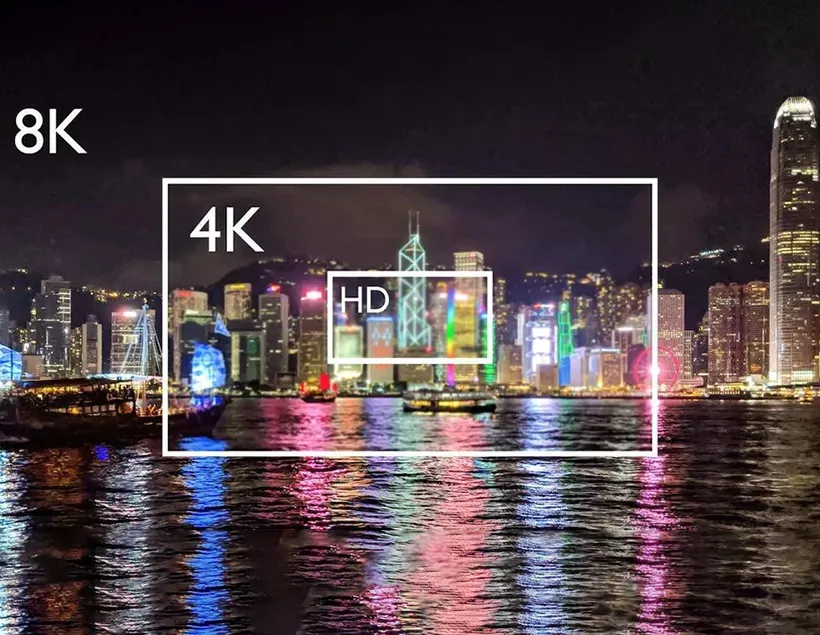
No. The SVRC-3120 is a data-only USB cable and does not carry DisplayPort Alt Mode video. Choose a full-function USB-C AOC if simultaneous USB data and display video are required.
9. Is the cable suitable for camera tethering?
Yes. Its 10Gbps bandwidth, long reach, EMI resistance, 60W PD support, and right-angle connector are designed to improve professional tethering setups. Compatibility should still be confirmed for the exact camera and software workflow.
10. What devices can it connect?
Typical compatible equipment includes USB-C cameras such as supported Sony, Canon, and Nikon models, MacBook and Windows computers, VR or AR devices, smartphones, USB 3.2 storage hardware, conferencing peripherals, and machine-vision equipment. Every device must support a compatible USB data mode.
11. Can the cable be customized?
Yes. Available customizations include length, connector mold or shell, right-angle or screw-lock design, and jacket materials such as TPE, CMP, LSZH, or TPU.
12. How should it be installed?
Avoid bends tighter than the stated 50mm radius, do not exceed mechanical load ratings, and verify that all connected equipment uses USB 3.2 or an explicitly supported backward-compatible USB mode. No host/device direction check is required.
A Practical 10Gbps Link for Professional USB-C Systems
The Elike SVRC-3120 is built for users who need more than a short consumer USB cable but do not need USB4, Thunderbolt, or display output. Its combination of 10Gbps USB 3.2 Gen 2 data, hybrid optical construction, true bidirectional connectors, up to 60W PD, and professional mechanical options creates a dependable link for imaging, storage, VR and AR, conferencing, education, machine vision, industrial equipment, and data-center workflows.
For OEM, ODM, and integration projects, Elike can also customize the cable length, connector shell, retention design, and jacket material to match the installation environment. Before specifying the cable, confirm the required USB protocol, power profile, connector geometry, and whether the application needs data only or full-function USB-C video.